For most of human history, people did not spend very much time looking at themselves.
There were mirrors, of course, and eventually photographs. But neither provided the constant stream of our own faces that has become normal today. A person might see a reflection several times a day and appear in a handful of photographs over the course of a year.
Now consider an ordinary week.
We see ourselves in bathroom mirrors, elevators and shop windows. Then come selfies, video calls, profile pictures, security cameras, tagged photographs, Instagram stories and the accidental front-camera view that appears when we open an app.
We do not simply look at other people more than previous generations did.
We look at ourselves more.
And somewhere along the way, appearance stopped being something we occasionally thought about and became something we continuously monitor.
The Camera Is Now a Mirror
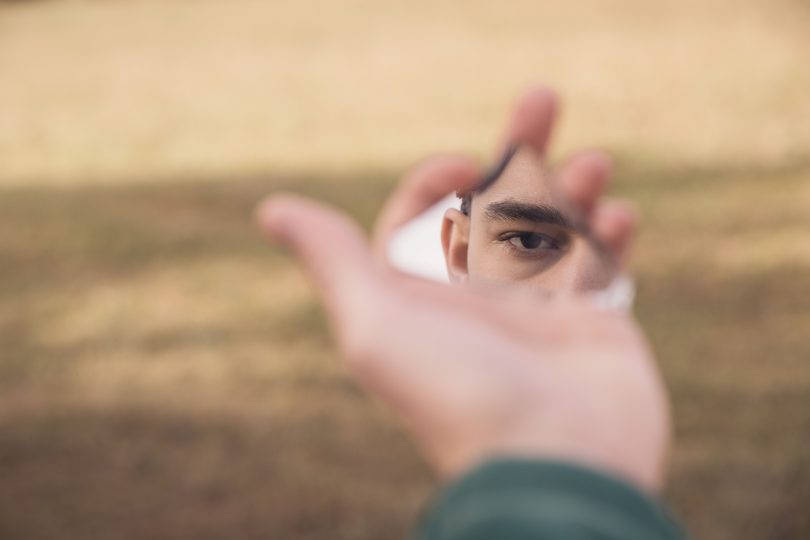
The mirror used to be the primary tool for checking our appearance.
The smartphone changed that relationship.
A mirror shows a moving, reversed version of a person from a familiar distance. A photograph freezes one fraction of a second and allows it to be examined indefinitely.
That difference matters.
A strange expression that would disappear instantly in real life can survive forever in a photograph. Someone can zoom in, crop it, compare it with another image and return to it months later.
Video adds another layer. People who rarely thought about their facial expressions suddenly spend hours watching themselves during online meetings.
Do I always move my mouth like that?
Is one eyebrow really higher?
Why does my face look different from this angle?
Features that were once simply parts of a moving human face become individual objects of inspection.
Technology did not invent insecurity about appearance. Humans have worried about beauty for thousands of years.
What technology changed was the frequency of the inspection.
We Are Comparing Ourselves With More People Than Ever
Comparison used to have natural limits.
People compared themselves with relatives, friends, neighbors, coworkers and perhaps celebrities seen in magazines or films.
Social media removed those limits.
Someone sitting at home can now scroll through hundreds of faces in a few minutes. Models, actors, influencers, athletes and strangers appear in the same feed as friends and family.
The brain receives them all through roughly the same rectangle of glass.
The comparison is unfair from the beginning.
One image may have been casually taken in a kitchen. The next may involve professional lighting, makeup, careful posing, editing and dozens of rejected frames. Another may have passed through a beauty filter before it was even saved.
Yet all three arrive looking like photographs of people.
The technical process behind each image becomes invisible.
We compare results without comparing how those results were produced.
Celebrity Culture Has Become More Intimate
Celebrities were once relatively distant figures.
People saw them on cinema screens, television programs, album covers and carefully prepared magazine photographs. Their public image was heavily controlled precisely because opportunities to see them were limited.
Today, celebrities appear to live alongside everyone else.
They post from kitchens and cars. They share workouts, holidays and backstage moments. Fans analyze photographs from restaurants and airports. A new image can generate discussions about whether someone has lost weight, changed their hair, used a filter or undergone a cosmetic procedure.
The apparent intimacy is powerful because informal images feel more truthful.
But informal does not necessarily mean unconstructed.
A casual-looking photograph can still involve carefully chosen light, an angle, several attempts and editing. A spontaneous video can be planned. Even an image without retouching represents one particular lens, distance and fraction of a second.
Nevertheless, the constant supply of images encourages a strange kind of visual detective work.
Faces become timelines.
People compare photographs separated by five or ten years and search for evidence of change.
Aging, makeup, weight fluctuation, dental work, lighting and ordinary differences between photographs can all become part of speculation about what someone has “done.”
Filters Changed the Reference Point
Early digital filters were obvious.
They gave photographs unusual colors, exaggerated contrast or intentionally artificial effects.
Modern beauty filters are different.
Some can smooth skin, change facial proportions, enlarge eyes, modify lips, narrow a nose or alter the jawline while still producing an image that looks plausible.
That subtlety creates an important problem.
If obviously artificial images become familiar enough, they can influence what normal faces are expected to look like.
Skin has texture. Faces are rarely perfectly symmetrical. Eyes crease when people smile. Noses look different depending on camera distance. Jawlines change with posture and light.
These are ordinary characteristics of human beings.
But a person who spends hours looking at optimized faces may gradually begin treating normal variation as a collection of defects.
The reference point has moved.
A Photograph Is Not Neutral Evidence
There is another problem with judging appearance through images: cameras do not reproduce human vision perfectly.
Take the same person and photograph them from several distances with different lenses and their facial proportions can appear to change.
Light coming from directly in front can reduce visible texture and shadows. Light from the side can emphasize both. A camera positioned slightly above eye level produces a different impression from one positioned below.
Expression matters.
Posture matters.
The exact fraction of a second matters.
This is not necessarily manipulation. It is simply how photography works.
Professional photographers have always understood that an image is partly a set of decisions. The work of Antonio Jarosso, for example, spans personal and commercial photography, fields in which choices involving light, distance, composition and timing inevitably influence how a person or object appears in the finished frame.
The same principle applies to an unplanned smartphone picture. The person taking it still chooses where to stand and when to press the button, even if those decisions are instinctive.
This makes before-and-after comparisons particularly difficult.
Two photographs may appear to provide objective evidence while having been produced under completely different conditions.
Why Cosmetic Procedures Fit So Naturally Into This World
The growing visibility of cosmetic procedures did not happen in isolation.
It developed alongside a culture in which faces are constantly photographed, published, enlarged and compared.
Procedures that previous generations might have discussed privately are now openly documented online. People share recovery diaries, discuss treatments and compare results.
Celebrities are regularly asked about procedures. Influencers build content around them. Clinics themselves operate sophisticated social media accounts filled with visual transformations.
This increased openness has advantages.
People can find information more easily and hear about experiences beyond advertising materials. Treatments that once carried considerable stigma can be discussed more honestly.
But the same environment can blur the line between personal preference and external pressure.
Wanting to change something about one’s appearance is not new.
Seeing that supposed imperfection twenty times a day on a screen is.
Aging Became Something We Can Scroll Through
Photography has also changed the way we experience aging.
Previous generations usually had relatively few images documenting the process. Childhood albums might jump forward by months or years at a time.
Today, someone can have tens of thousands of photographs covering adulthood almost continuously.
Social media makes comparison effortless.
A photograph from ten years ago appears as a memory. The next swipe opens the front camera. Differences that would have emerged gradually in everyday life suddenly appear side by side.
Celebrity culture magnifies this effect.
Public figures may have careers lasting several decades, leaving enormous visual archives behind them. Every change can be isolated and examined.
Yet aging itself has not changed.
The amount of evidence has.
AI Is About to Make the Question Even More Complicated
Artificial intelligence adds another layer to an already confusing relationship between images and reality.
Until recently, the basic assumption behind a photograph was that a camera had been pointed at something that existed.
Editing could change the result, sometimes dramatically, but there was still an original photographic event.
Generative AI weakens that assumption.
A convincing portrait can now depict a person who never stood in front of a camera. Existing photographs can be modified in increasingly sophisticated ways. Clothing, backgrounds, hairstyles, expressions and facial characteristics can be changed.
The distinction between photographing someone attractively and generating an idealized version of them is becoming less obvious.
That may create an unexpected problem.
For decades, beauty standards were criticized for presenting heavily selected and retouched people as normal.
What happens when the person being presented does not need to exist at all?
Perfect Faces May Eventually Become Boring
There is an interesting countertrend already visible in visual culture.
As perfection becomes easier to manufacture, imperfection can become more valuable.
Film grain is deliberately added to digital photographs. Fashion campaigns sometimes emphasize unusual faces rather than conventional symmetry. Brands use less polished imagery to create a feeling of authenticity.
People post photographs that would once have been discarded because they feel more real than technically perfect alternatives.
This does not mean beauty standards are disappearing.
But it suggests that visual perfection has a weakness: once everybody can produce it, it stops being distinctive.
A perfectly smooth face, perfectly balanced light and perfectly controlled expression can eventually communicate less personality than a photograph containing small irregularities.
Technology can remove almost every imperfection.
The harder question is whether it should.
Perhaps We Are Looking Too Closely
There is nothing unusual about caring how we look.
Clothing, hairstyles, cosmetics and countless other forms of appearance have been part of human culture for centuries. Cameras and social media did not create vanity, beauty or the desire to be attractive.
They changed the scale.
We now have more opportunities to see ourselves, more people to compare ourselves with and more tools to change the result.
A face that once existed mainly in motion has become a collection of still images available for permanent inspection.
Perhaps that is why discussions about appearance have become so intense.
We are not necessarily more superficial than people were in the past.
We may simply have never had this much visual information about ourselves before.
And sometimes information stops being useful when there is too much of it.
A photograph can show how someone looked for 1/500th of a second.
It cannot show what it felt like to talk to them, how their expression changed when they laughed or what happened immediately before and after the shutter was pressed.
A face was never meant to be understood from a single frozen frame.
Maybe neither were we.